Tuesday, July 7, 2009

Italian Wedding Customs

There is just something so romantic about Italy. It is the wine, the food, the ambience, and above all, the warmth and passion of the Italians. Having a destination wedding in Italy would be truly incredible. But even if you cannot transport your wedding to the Tuscan countryside, you can bring some of the exuberant spirit of an Italian wedding home.

Weddings are a very big deal in Italy. They are about more than just the marriage of one man and one woman; weddings are also the union of two families and all of their friends. This is a cause for great celebration! Italian weddings often start with a Nuptial Mass in the morning, followed by feasting, drinking, and dancing that can last well into the next day. (Tip: if you are having a full Catholic Nuptial Mass, it should be indicated on your invitations.)

Speaking of feasting, food is of paramount importance for any Italian special occasion. Food has strong associations with family and togetherness in Italy, so of course at a wedding reception, everyone will want to mange. The wedding dinner often consists of up to fourteen courses, followed by cake with espresso and coffee (to aid in dancing until dawn, no doubt). Whether your wedding is in the United States or in Italy, treat your guests to a proper Italian wedding feast. If your wedding is in America, a wonderful way to honor your Italian ancestry would be to serve the dishes that are the specialty of the region from which your family hails. Skip generic Italian-American dishes in favor of true authentic Italian cuisine.

The Italians have some very charming pre-wedding traditions that any American bride would love. It is customary for a young man to serenade his beloved with music before proposing marriage (if he is tone deaf, he can bring along friends to help out). How romantic is that? Also incredibly romantic is the reason that Italians give diamond engagement rings: they believe that diamonds are created by the flames of love. Ladies, are you swooning yet?

As with any wedding, la sposa (the bride) is the center of the day. The wedding gown is very important to Italian brides, and they have a great variety from which to choose. Traditional long sleeve gowns are still seen for Nuptial Masses, but so are all manner of gowns from modern to fanciful. Simplicity is valued by some brides, but many love the fine laces and embellishments that are offered by designers. Since Italian lace is some of the finest in the world, it would be perfect for an Italian wedding gown. Veils are usually worn, as they were once thought to protect the bride from evil spirits. Italian women love jewelry, but there is a superstition that says a bride should not wear any gold on her wedding day until the groom gives her the wedding band. To play it safe, choose custom bridal jewelry handcrafted with sterling silver. Sparkling Swarovski crystals and lustrous pearls can be intertwined with the sterling silver to create fabulous custom bridal jewelry that is both unique and affordable.

The Italians have many other delightful customs that you can include in your wedding. One fun tradition is for the couple to shatter a vase or glass at the end of the evening. It is said that for every shard of glass, the newlyweds will have a year of happiness. The Romans would break a loaf of wheat bread over the bride and groom for fertility. For good luck, the guests ate the crumbs. Another good luck charm used by Italians is a piece of iron that the groom carries in his pocket to drive away jealous evil spirits.

For couples who have Italian heritage, highlighting the wedding customs of Italy is a very special way to honor your relatives while personalizing your event. Even if you do not have a single drop of Italian blood, it would be fun to include some of the joyous spirit of the Italians in your wedding festivities. And don't forget to raise a glass to the favorite Italian wedding toast, "Per cent'anni!" (for a hundred years).


By : Phie

Choosing Your Wedding Dress Neckline

After deciding on the shape of your gown, the next step is to choose the style of neckline. The neckline is probably the most prominent aspect of a wedding gown, and because it also draws attention to your face, it's worth spending some time considering your options.

Necklines vary in style. Some sit high and others, low. Some reveal a lot of skin, while others are more modest. Your choice depends on what appeals to you and on your physical characteristics, such as the size of your bust, the width and shape of your shoulders and arms, and the length of you neck. You should also think about how your fair will be styled and what accessories you want to wear before making a final decision. To help you with your selection, here are the 10 most popular necklines.

Strapless Offers a classic, timeless look. Complements square shoulders and accents the collarbone. Enhances a small bust and is perfect for embellishments such as beading.

Asymmetric Features a simple yet striking one-shoulder style line. Enhances not-too-broad shoulders and arms. Best suited to small to medium-sized busts. Minimal need for accessories.

V-Neck Flattering for most bust sizes, especially fuller busts. Lengthens the neck and widens narrow shoulders. Ideal for swept-up hairstyles and showcasing bold jewellery.

Boat Neck Follows the line of the collarbone and gives great coverage for a sleeveless style. Widens narrow shoulders and elongates the neck. Best for small to medium-sized busts.

Sweetheart Features a low-cut neckline in the shape of the top half of a heart. Perfect for showing some tasteful cleavage. Softens the look of a strapless neckline.

Halter-Neck Neckline can be high or plunge deeply and is well suited to a low-cut back. Showcases toned shoulders and arms. Suits a small bust, but not broad shoulders or narrow shoulders.

Spaghetti Straps Softens the strapless neckline, with fine straps giving a delicate, feminine look. Offers potential for creative strap detailing and ornamentation. Enhances small busts and narrow shoulders.

Portrait Features a wide, soft scoop that spans across the shoulders. Widens narrow shoulders and chest. Shows off great collarbones, but not suited to bony collarbones.

Scoop Neck A softer version of the V-Neck. Also known as the ballerina neckline. Widens a narrow chest, lengthens the neck and minimizes a large bust. Suits all styles of gown and body shapes.

Off-The-Shoulder Flattering for fuller busts, although a strapless bra is required. Lengthens the neck and shows off the collarbone. Provides coverage for upper shoulder and arm areas and a perfect focus for jewellery.


By : Phie

Beauty of Ivory Wedding Dress

It is a worldwide tradition that the brides should be in white on the wedding day. It is beyond doubt that many brides look gorgeous in stark-white dresses but those women who have fair skin complexion do not. These brides look pale and insignificant when they have white clothes on. Red-haired women also look improper and a bit weird in a traditional white dress. A great way of handling this problem for the two types of brides mentioned above is to wear an ivory wedding dress.

All the styles of traditional white gowns have an ivory wedding dress equivalent. The idea of adding a little colour to your dress but still wearing "white" on your wedding is appealing to many women. Gowns in this beautiful colour suit almost every skin tone and they do not make the ladies wearing them look washed out, nor pale.

Many women like to have quite many beauty-enhancing procedures before their special occasion. In case you have rich, dark hair and you have tanned skin, sticking to the traditional white bridal dress is a good idea. Women of colour could also only benefit from choosing a stark-white gown for the big day as the skin tones are rich and beautiful. If you are one of the types mentioned here, then you don't have to worry about looking washed out regardless of the stark white. The contrast can only make you look stunning.

However, there are many women who do not tan but get sun-burnt during the summer. These ladies are advised to go for an ivory wedding dress. The added colours will offset fair complexion whereas stark white would simply wash it away. Avoid washing off your alabaster skin by choosing an ivory bridal attire.

Red-haired ladies should also consider an ivory wedding dress. Generally, there are two kinds of redheads. The first kind is the classic red, the second - the auburn redhead. While the first has natural curls with orange-red locks, the second might look like a brunette in certain lighting. I am an auburn redhead, so the last statement concerns me.

Despite having auburn hair I don't burn-peel-freckle. I wasn't really worried that I may look washed out in a traditional white bridal gown. Though, I found that an ivory wedding dress suits me better. I had to try many white gowns which for some reason were not right until I finally put on an ivory wedding dress.

After I tried it on, I couldn't think of choosing a stark-white gown again. The ivory bridal attire suited the auburn highlights in my hair. Even though my dress was not really white it looked quite white as the attendants were wearing burgundy-wine gowns. In conclusion, keeping an open mind when choosing a wedding dress is always a good idea.


By : Phie

Monday, July 6, 2009

Indian and Pakistani wedding Dress

A wedding is an occasion of great importance in all parts and cultures of the world. It is a ceremony to celebrate a marriage or civil union, and it’s always celebrated with great fun and festivity. A wedding ceremony is usually comprised of several wedding traditions and customs that vary greatly between cultures, ethnic groups, religions, countries, and social classes.

A traditional wedding is always a nice expo of culture and customs of a place. It’s always considered incomplete without the typical wedding dresses that reflect the culture & heritage of a place. A wedding dress is traditional clothing that is usually donned by a bride or a groom.

The colors, styles and ceremonial importance of wedding dresses depend on the respective religions and cultures of brides and grooms. Wedding dresses broadly include grooms’ wedding dresses and brides’ wedding dresses or bridal dresses. This article will be broadly focusing on the different wedding dresses including brides’ as well as grooms’ wedding dresses popular in different cultures, and societies of India and Pakistan. Generally the brides and the grooms in both countries wear the dresses that help presenting them in the most favorable light.

Pakistan is a country located in South Asia and the Greater Middle East. The country was part of India before 1947, so there is close cultural affinity in both the countries. The wedding dresses and culture of Indian Punjab is almost similar to that of the Pakistani Punjab. The wedding dresses of Indian Muslims are almost similar to the wedding dresses of Pakistani Muslims. Hindus, Christians, and Sikhs are in meager minority in Pakistan however they follow the same wedding customs and traditions as followed by Indian Hindus and Sikhs.

India is the country of many religions, cultures, and ethnic groups. There are different styles of wedding dresses popular in different parts of India. The North Indian wedding dresses are utterly different from the South Indian, and the East Indian wedding dresses.

Wedding Dresses For Grooms—The South Indian grooms’ traditional wedding dress includes traditional “veshti” or “vetti” (dhoti) and “kurta”. A Dhoti is a traditional garment of men's wear in India. It is a rectangular piece of unstitched cloth, usually around 5 yards long, wrapped about the waist and the legs, and knotted at the waist. Dhoti is called “Laacha” in Punjabi, “mundu” in Malayalam, “dhuti” in Bangla, “vetti” in Tamil, “pancha” in Telugu, “dhotar” in Marathi and “panche” in Kannada. A kurta is a traditional item of men clothing. It is a loose shirt falling either just above or somewhere below the knees of the wearer. It’s also worn with salwar, and churidar. The South Indian grooms also wear their traditional caps with veils of flowers.

The North Indian grooms’ and the Pakistani grooms’ traditional wedding dress includes traditional “sherwani” with a “churidar pyjama,” a “bandha gala” suit. Sherwani is a long coat-like garment worn in South Asia. It’s very similar to an Achkan or doublet. Sherwani is worn by Punjabi, Hindu, and Muslim grooms. It is worn over the Kurta with Churidar, Khara pajama, or a salwar. “Churidar” is a tight-fitting variant of a salwar. Pajama is a parallel fitting variant of Salwar. A Salwar is loose pajama like trousers that is wider at waist and thighs, and tapering to the bottom, it is stitched narrow at the bottoms. Indian and Pakistani Muslim grooms’ traditional wedding dress includes “Salwar Kamiz” and “Sherwani.”

In fact Salwar Kameez is the males’ national dress of Pakistan. It’s very popular among Pathans, Khans, Balochs, etc. It’s also very popular among Afghanis. “Salwar Kamiz” and “Sherwani” is very popular male wedding dress. Silk or any other similar level textile is the most preferred textile for wedding Salwar Kameez. High quality fabric is used for Sherwani. Indian as well as Pakistani Muslim grooms also wear Mohammedan caps on their heads. Some Hindus wear caps and some wear turbans, but Punjabi grooms wear turbans. The North Indian grooms set forth to their weddings adorned with a “sehera,” a veil of flowers tied to the turban, to screen their faces from the evil eye. The Punjabi dress up like royal kings and sometimes wear plume on their turbans. They also hold swords like princes. The Indian Christian grooms normally wear western style suits.

Under the influence of west most of the Indian and Pakistan males have started wearing western style suits as their wedding dresses. Three-piece suits and western style suits are pretty popular grooms’ wedding dresses in India and Pakistan. Usually Silk or superior quality textile is used to tailor Indian grooms’ wedding dresses.

Wedding Dresses For Brides— Sari is women’s national dress of India. Sari is the most popular bridal dress that is worn by most of the Indian Hindu brides. Sari or Saree is several yards of light textile that is draped around the body. Expensive sarees are worn as bridal dresses by most of the south Indian brides and the North Indian Hindu brides. Mostly Silk sarees or other richly embroidered opulent and expensive sarees are preferred as bridal dresses. Usually, maroon, magenta, pink, and red are popular traditional colors in Saree bridal dresses. The South Indian brides also wear their traditional headdresses or headgears.
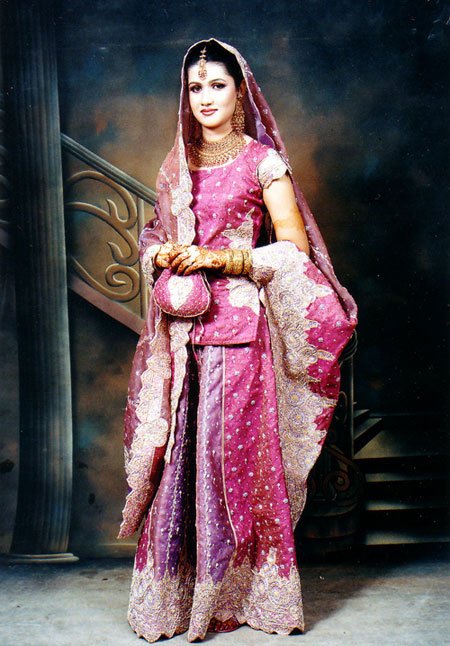
“Ghagra Choli” is also worn as bridal dress in some parts of the North India. Ghagra Choli consists of a long skirt and short blouse with a long scarf known as a “dupatta” draped around the bride. It’s known as “Lehenga Choli” in Punjab and Haryana.

Indian Punjabi brides usually wear “Lehnga Choli” or “Ghagra Choli” and “dupatta”. The traditional colors of maroon, burgundy, pink, red or wine shades are generally the popular choices in “Ghagra Choli”. The Punjabi brides also wear “salwar kamiz” that are popular called “Punjabi Suit”. Red shades usually dominate the Punjabi bridal dresses. The Punjabi brides usually wear “Punjabi Juttis.” Punjabi style shoes in their feet. Usually silk or some other very superior quality textile is used for bridal dresses.

“Lehnga Cholis” or “Ghagra Cholis” are popularly worn by the Pakistani brides. Punjabi suits (salwar kamiz) are also worn by many Pakistani Punjabi brides; however some of the traditional Pakistani Punjabi Muslim brides do wear “burkahs” or pardah in place of “dupatta”. Kurti is also worn by some of the traditional Pakistani brides. Kurti is male kurta like traditional piece of clothing worn by women in northern India, Pakistan, and Afghanistan.

Indian as well as Pakistani Christian brides usually wear expensive wedding gowns or western style wedding dresses. Traditional color of the western wedding dresses in white. 'White' or 'wedding white' includes creamy shades such as eggshell, ecru and ivory. The Christian brides in both the countries wear stylish western high heel sandals

Traditionally, Indian and Pakistani Brides are required to keep their faces hidden in veil. In most of the liberal societies in India, just covering head with dupatta or an end of saree is sufficient, but the traditional Pakistani societies just required the brides to keep their faces hidden. Indian and Pakistani Bridal dresses have excellent embroidery works at necklines and front hems. Some expensive bridal dresses carry rich embroidery of gold or silver fibers. Indian and Pakistani Bridal dresses are sometimes nicely embroidered using beads and sparklers. Indian and Pakistani Bridal dresses also include rich expensive jewelry.

You can get Indian and Pakistani wedding dresses tailored from some expert tailors, or you can buy “Ready To Wear” Indian and Pakistani wedding dresses from some fine Indian wedding dress stores and Pakistani wedding dress stores. You can also buy Indian and Pakistani wedding dresses online. There are numerous online wedding dress stores selling fine Indian wedding dresses and Pakistani wedding dresses online. Doing some research on Internet, you can also find cheap wedding dresses, discount wedding dresses, beach wedding dresses, plus size wedding dresses, informal wedding dresses, casual wedding dresses, vintage wedding dresses, and designer wedding dresses.


By : Phie

Salwar Kameez , Traditional Dress of South Asia

Salwar Kameez is a traditional dress of South Asia. Also termed as “Shalwar Kameez” or “Shalwar Qamis,” Salwar Kameez, is popularly worn in Pakistan, Afghanistan, Bangladesh and India. Salwar Kameez is also called “Punjabi suit,” because it is very popular in both Indian and Pakistani Punjabs. Salwar Kameez is commonly worn by Punjabi, Hindu, Muslim women, and Muslim males in India. It is popularly worn by Pakistanis and Afghans.

Salwar is called “salwar” in Punjabi and Hindi, “Shalwaar” in Gujarat, and “Shalwar” (شلوار قمیض) in Urdu. The word “Salwar” has actually come from Persian, and the word “kameez” has come from the Arabic word “Qamis.”

A Salwar is loose pajama like trousers that is wider at waist and thighs, and tapering to the bottom, it is stitched narrow at the bottoms. Salwars are usually pleated at the waist and held up by a drawstring or an elastic belt, or a woven cord called “Naala” or “Naada”. There are different styles prevalent among women, but males usually wear normal Salwars. Usually both men and women salwars are wide like baggies, but some fashionable women wear tight figure hugging salwars called “Pyjamies” or “Churidar” or “Churidar Pyjamies.” “Patiala Shahi Salwars” are very popular in Patiala and Malwa Region of Indian Punjab. These are usually loose salwars that have pleated front and back. Patiala is also famous for woven waist cords (“Naalas” or “Naadas”).

A Kameez is a long shirt or tunic with open side seams. The side seams, known as “chaak,” are left open below the waist-line to give a wearer greater freedom of movement. Traditional kamiz (plural of “kameez”) are cut straight and flat and have traditional side cuts, but a modern kamiz are more likely to have European-inspired set-in sleeves. Traditional kamiz, for both men and women, usually have normal or loose fitting, but some fashionable women do wear tight figure hugging kamiz. Usually, fine tailoring skills are displayed in stitching a kameez. Specifically necklines of kamiz are tailored beautifully. The necklines can be simple, decorative, embroidered, or beaded, etc.

Salwar kameez is very popular among Punjabi and North Indian Women. Women Salwar Kameez is usually accompanied by “Dupatta,” which is a long scarf or shawl like cloth made of light fabric. Women wear salwar-kamiz along with wearing “dupattas’ around their heads or necks. Often the Punjabi and North Indian Hindu women use their “dupattas” to cover their heads at religious places or religious ceremonies. However the Muslim women usually wear the chador or burqa (hijab and purdah).

Modern Salwar Kameez is modernized version of traditional Salwar Kameez. Some Modern feminine Salwar Kamiz have deep cut plunging necklines, short length, tight figure hugging fitting, styled in sleeveless or cap-sleeve designs, and sewn in diaphanous fabrics.

Sometimes women wear kamiz having side seams splited high up to the waistline, or salwars slung low on the hips. Some ultra modern women wear semi-transparent Salwar kamiz mostly in parties, but they do wear a choli or a cropped camisole underneath.

Salwar Kamiz are usually tailored using different types of fabrics. Most common fabrics used to tailor Salwar Kamiz include cotton, chiffon, silk, banarsi fabrics. Cotton is a soft breathable textile used for daily clothing. It is usually used for the salwar kamiz that are meant for general daily use or worn in routine life. Cotton is very preferable summer season fabric. It’s a comfortable to wear fabric and offers easy ventilation of air, and thus minimizes the heat effect of the summer season. Cotton slawar kameez usually costs less. Cotton, being an inexpensive fabric, is commonly preferred for daily use Salwar kamiz.

Chiffon is a lightweight sheer material with a slightly rough feel to it. It can be made from cotton, silk or synthetic fibers, but is usually associated with silk or nylon. The best thing about chiffon is that it can be dyed to almost any shade desired, however if made from polyester it is difficult to dye. Chiffon is sometimes also used for daily use salwar kameez. The fabric is finer that cotton and thus more costly than the latter. Chiffon is also a common summer textile. Chiffon Salwar Kameez may cost little more than the Cotton Salwar Kameez, but looks finer than the latter. Chiffon Salwar Kameez is usually worn by the fashionable lot of men and women.

Silk is a fine quality woven textile. It is a very popular textile all over the world. Silk offers opulent looks to clothing. The fabric is soft, velvety, marked with luxurious looks. Silk is usually available in most of the popular colors. It’s one of the most coveted fabrics for the ornamented Salwar Kameez. Silk is usually preferred for tailoring party wear salwar kameez. Silk Salwar Kamiz are usually worn on parties, and special occasions like weddings, anniversaries. Silk is very popular salwar kameez fabric among the salwar kameez wearing people all over the world. Silk Salwar Kameez is one of the expensive wears.

Salwar Kamiz are also tailored using several other popular textiles including banarsi silk, and several other locally and some imported textiles. Usually fine quality light textiles are preferred for tailoring Salwar Kamiz.

There is a wide rage of styles and designs of Salwar Kamiz ranging from simple to highly ornamental. Ornamental Salwar Kamiz usually have works of fine embroidery at neckline and from front hem of Kamiz. The women kamiz hems may also have beautiful bead work, mirror work, or sparkler work. Silk thread is commonly used for embroidery. Gold and silver fibers are also used for embroidery. The embroidered Salwar Kamiz are usually expensive.

Salwar Kamiz can be got tailored from expert tailors. Traditional women usually prefer women tailors for getting their salwar kamiz tailored. There are a lot of male and female tailors designing and stitching Salwar Kamiz. However ready to wear Salwar Kamiz are also available. Ready made salwar kamiz can be purchased from boutiques and ready to wear Salwar Kamiz stores. Salwar Kamiz can also be purchased online. There are numerous online garment stores selling traditional clothes online. The best idea to buy Salwar Kameez online is, doing some research online to fine a good store online. Research will help to find the store selling cheap salwar kamiz, or discounted salwar kamiz, and thus will help to save a lot of money.

Friday, July 3, 2009

Toby + Amy: Whooo knew

We knew! From the moment we saw Toby and Amy together, we knew that they were made for each other. Amy brought out the best in Toby, which made us immediately love her. Of course I couldn't have been more thrilled when I learned that she was going to be my new sister- in- law!

As I was brainstorming with Amy and Toby about a concept for their wedding, Amy's love of owls and trees kept coming up. Amy has quite the collection of owls and I wanted to find a way to incorporate that element into their wedding. One of my first steps was in locating a site for them. This was going to be an out of state wedding for me which always requires a little more research but Millcreek Inn in Salt Lake City, Utah seemed to be the perfect backdrop. Being up the canyon it offered a rustic feel but allowed for just the right opportunity to add an updated look.

Amy wanted a clean, streamlined and somewhat urban look and when I found these white ceramic owls at Z Gallerie I knew they would be just the right thing to add to the centerpieces. I loved the chic and stylish feel of them and immediately pictured them on a bed of yellow mums.

I worked closely with Liz at Whimsy Flowers to develop the vision and they did an amazing job. All of the flowers in deep hues of oranges and yellows were beautiful! ...and the rununculus were still in season there which was a happy surprise.


May 9th was a beautiful day...a little crisp and cool, but a beautiful spring day. It was a reminder of what was important. It had been a particurlarly difficult week. My mother-in-law still refers to it as " the week that was" and it is worthy of such a title. We had driven up to Utah and buried my husband's sister just four days prior to the wedding. Her passing had been unexpected. We had planned on attending solely my brother-in-law's wedding that week but things quickly changed and we adjusted the best way we could. It had been upsetting and emotional but the wedding became a blessing of sorts, forcing us to switch gears and focus on something happy.

Following the funeral on Monday, we pulled together to finish the final details and give Toby and Amy the wonderful happy occasion that they deserved. It was a busy next few days of gathering and finalizing and building (many of you may remember the nail that went into my husband's finger this week as he was building a cake box stand for the wedding). It seemed as if one difficult thing followed the next.


...and then the day came and for one brief hour inside the temple there was peace... a warm comforting peace as we watched Toby and Amy sealed for all time and eternity. It reminded us that there was an eternity and that our family would be together forever. The room was full with the exception of an empty chair in the front row. It seemed to be saved for Patrice.


This was truly a week of all types of tears...tears of sadness, of frustration, some of exaustion but also of joy. The end of one journey marked the beginning of another.


This may be one of my very favorite pictures by Jason McGrew. I love the feeling of it, the rich wood texture and the intricate detailing of the antique doorknobs. It seems to symbolize so much on so many levels.....the door to marriage and to something sacred and special. I love it.
I loved amy's toes and fingers that were painted orange...just to keep things fun.


After the temple ceremony, we were off to an intimate luncheon given by my mother-in-law. I'm still amazed by her ability and strength to carry on despite so many trials. She may be one of the most selfless women that I know, always putting others first whenever there is an opportunity to serve.

I know that her own marriage and the relationship she has with my father-in-law is rare and precious and a source of great strength to her as well. There is a quiet beauty in Marriage that not every0ne always sees. The support that sometimes only that one person can provide.

Its incomprehensible to think when you're just starting off in marriage about how many things you will go through with that person. How many things you will endure that you may never have thought yourself capable of and all because you have them standing right next to you through it. I don't believe there is any decision more important than the person you choose to marry.


There were toasts and more tears....


and then ......

Thursday, July 2, 2009

The Butterfly Effect

I love, love, love a beautiful bridal bouquet. It can be the perfect accessory to complete any bridal look. But when this fun, youthful take on the traditional bridal bouquet fluttered my way, I just couldn't help smiling. I adore the varying sizes, shapes and colors of the different delicate butterflies. They remind me of flying flowers, floating gracefully down the isle.


The surprising joy and artistry of this insect inspiration, pulled from Martha Stewart Weddings, has understated elegance that could only enhance the bride's charm. I'm fortunate to work with Twigg Botanicals on most of my bridal flowers and arrangements, and absoloutely love playing with different elements to completely change the look of a wedding. It's personal, unique details such as this that take an ordinary wedding to a breathtaking, unforgettable day.